
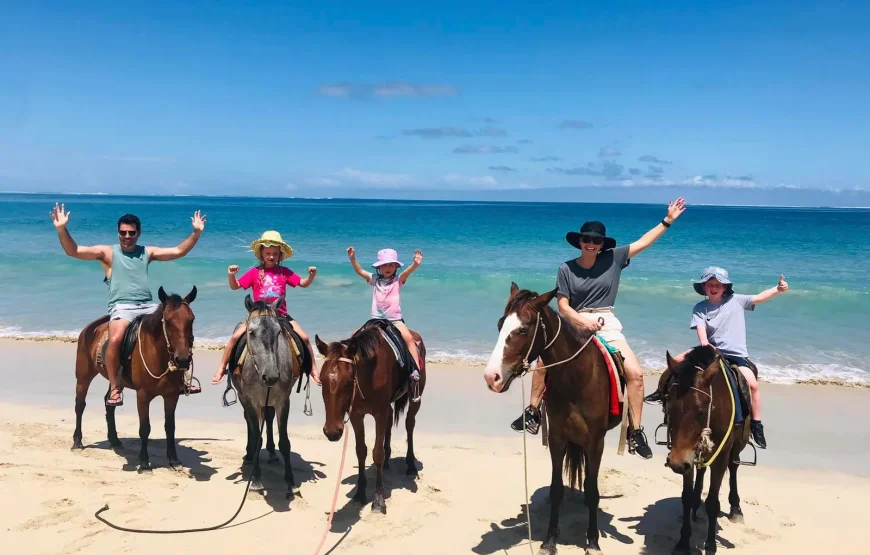

Most families who come through our stables on the Coral Coast have done some version of the same planning sequence. They’ve booked Denarau because everyone said to, they’re nervous about the flight, and they’re trying to figure out which activities their 6-year-old can actually do without melting down in the heat. They’ve read a dozen brochure pages that all sound the same and they still don’t know whether to book the day cruise or skip it.
This guide is what we’d tell them sitting at the saddling rail before a ride. It’s the practical answer to the questions families actually ask before booking — written from the Coral Coast, with input from operators we work with across the country. Prices are in Fijian dollars (FJD) unless noted, and we’ve dated everything so you can tell what’s still current.
Is Fiji a good destination for kids?
Short answer: yes, and at most ages it’s one of the easier long-haul options.
The longer answer depends on what you’re optimising for. Fiji is unusually strong on:
- Warm, shallow water at most family beaches, which makes swimming and snorkelling accessible for younger kids than you’d manage in Indonesia or the Philippines.
- English as a working language, which removes a lot of the friction families hit in much of Asia.
- Genuinely good kids’ clubs at the mid-range and above. The Fijian hospitality culture extends to children in a way that doesn’t always translate at comparable resorts elsewhere — our staff regularly come back from days off having attended a niece’s birthday with thirty kids running around. Kids are just part of life here, not a category.
- Short distances. The main island (Viti Levu) is small enough that you can base yourself in one spot and still see plenty.
- Low malaria risk. Fiji is malaria-free, which removes a major planning headache.
Where Fiji is less strong for families:
- Long flight time from North America and Europe. Most of our family visitors come from Australia and New Zealand, where it’s an easy 3–4 hour hop. From the UK or eastern US it’s a serious commitment.
- Limited inland infrastructure. If you want to do significant interior touring with small children, the road quality and the lack of car seats in transfers make it harder than it should be.
- Resort costs at the top tier. Family villas at the premier resorts can be eye-watering. The mid-range is excellent value; the top end isn’t.
What’s the best age to take kids to Fiji?
Honestly, almost any age works, but the experience changes a lot depending on the kids you’ve got.
Babies and toddlers (0–3). Fiji handles infants well. The flight is the hardest part. Resorts mostly have cots; the warm shallow water at protected beaches is ideal for kids who can’t swim yet. The downside is you’ll be tied to resort facilities — the off-resort activity menu mostly opens up at 5 or 6.
Early primary (4–7). This is the sweet spot for most families. Kids’ clubs across the Denarau and Coral Coast resorts are best for this age range. Most things become possible — beach activities, supervised snorkelling in shallow reefs, short cultural visits. Our youngest regular rider is four, who came down with her grandparents from Sydney last winter and rode at a walk with a lead rope while her grandfather kept pace alongside.
Later primary (8–11). The age where Fiji genuinely shines. Kids can do almost everything adults can: proper snorkelling, day-boat trips to outer islands, horse riding with the option to trot, cultural workshops, light hiking. Several of our family bookings each month are in this bracket, and they’re usually the ones who finish the ride asking when they can come back.
Teenagers (12+). The challenge here isn’t capability, it’s interest. Most resort kids’ clubs cap at 12 or 13, leaving teenagers in an awkward middle zone — too old for the club, too young for the bar. The fix is choosing a resort with a teen programme (a small number of Denarau resorts run them) or planning a more activity-led trip with surfing, diving, or zip-lining. Honestly, a teenager who’d rather scroll their phone than ride a horse on a beach is not a teenager Fiji is going to fix; but a teenager who’s up for it has more on offer here than most places.

When is the best time to visit Fiji with kids?
Fiji has two seasons. The dry season runs roughly May to October, with daytime temperatures around 25–28°C, lower humidity, and mostly sunny days. The wet season runs November to April, with hotter, more humid weather and frequent short, heavy downpours. Cyclones are technically possible January through March; significant events are rare and heavily forecast.
For families specifically:
- The school-holiday peak in Australia and New Zealand (late June to mid-July, and parts of September) is the busiest and most expensive period. Resorts get crowded, kids’ clubs hit capacity, and accommodation prices jump 30–50%.
- The shoulder weeks in late May and September are the sweet spot — dry-season weather without the peak crowds and prices. If you have any flexibility at all, this is the move.
- The wet season is genuinely fine for a family trip if you’re flexible. Mornings are usually clear; afternoon storms pass within an hour. The benefit is lower prices, quieter beaches, and a greener landscape. The risk is that one bad week of weather affects pool-and-beach holidays more than activity holidays.
If your kids are young enough that they’ll mostly be at the resort pool, the dry season matters more. If they’re old enough for activities, the wet season is genuinely viable.
Which region of Fiji is best for families?
Most families should choose between three regions on the main island, plus the outer-island option.
Denarau. The cluster of large resorts on a man-made peninsula 20 minutes from Nadi airport. Pros: shortest transfer time, biggest kids’ clubs, all the big-brand resorts (Sheraton, Hilton, Sofitel, Westin, Radisson), a marina with restaurants and shops, an inter-resort beach walk, the Bula Bus loop. Cons: the beach itself isn’t Fiji’s best — it’s a working tidal flat for much of the day, and you’re not seeing the Fiji of postcards from the pool.
Coral Coast. The south-west coast of Viti Levu, about an hour to ninety minutes from Nadi airport. This is where we are. Pros: better beaches, more authentic feel, smaller and more spread-out resorts, easier access to land-based activities like horse riding, cultural villages, and the Sigatoka Sand Dunes. Cons: longer transfer, fewer mega-resorts, and you’ll likely want to do at least one organised activity to make the most of the location.
The Mamanucas and Yasawas. Small island resorts reached by ferry from Port Denarau. Pros: postcard Fiji — small, often beautiful, often with house-reef snorkelling off the beach. Cons: ferry transfers add half a day each way, fewer kids’ facilities at the smaller resorts, food and activity options limited to what the resort offers. A combination trip (a few nights in Denarau, then a few on an outer island) is often the sweet spot for families with kids over 5.
How long should a Fiji family trip be?
For families coming from Australia or New Zealand, a week is the standard minimum and ten days is the sweet spot. The first two days are largely about settling in and recovering from the flight; the last day is travel. So a 7-night trip gives you about 5 active days, which feels short by the time you’ve factored in the days you’ll want to do nothing at all.
For families coming from further afield (UK, North America, Europe), ten to fourteen nights is more sensible — you’ve earned the time by the length of the flight. A combination of Denarau or Coral Coast plus a few nights on an outer island works well at this length.
What does a Fiji family trip actually cost?
Real numbers for a family of four (two adults, two kids) on a 7-night trip, before flights, based on mid-2026 rates:
- Budget tier (3–3.5 star resort, basic room, breakfast included, minimal extras): roughly FJ$4,000–6,000 all in.
- Mid-range (4-star resort, family room or interconnecting, breakfast and dinner, one or two paid activities): roughly FJ$8,000–12,000.
- Premium (5-star resort, family villa, most meals, multiple activities, transfers): roughly FJ$15,000–25,000+.
The costs that catch families out — usually around day three, when they check their room balance for the first time:
- Transfers from Nadi airport are not included in most resort rates. Budget FJ$80–200 each way for a private transfer depending on destination.
- Resort food and drink is expensive by tropical-destination standards. Even at a mid-range resort, a family lunch with drinks runs FJ$80–150.
- Activity costs add up fast. A half-day snorkelling trip, a cultural village visit, and a horse ride for a family of four can easily run FJ$800–1,200 across the week.
- The cashless resort system means everything is charged to your room, which makes the bill at the end larger than you expected. Set a mental daily budget and check your balance at reception every couple of days.
What activities work for kids in Fiji?
The full breakdown is in our activities by kid age guide, but the headline answer:
- Swimming and beach play works at any age.
- Snorkelling opens up around 5 or 6 with shallow-reef supervision, and properly from about 8.
- Horse riding on the beach works from about 6 at a walk; we run regular family rides at Natadola Bay with horses chosen specifically for beginners and kids. Our combination ride with lovo lunch is the one most families end up choosing if they only have time for one big activity day.
- Cultural village visits are accessible at any age, but kids 5+ get the most from them.
- Day-boat trips to outer islands generally work from 4–5 upwards, depending on sea conditions and how well your kid handles a small boat.
- Zip-lining, river tubing, and similar adventure activities have varying age minimums — usually 5–7 for the family-rated versions.
- Surfing lessons start from about 8 with reputable instructors.
Getting around Fiji with kids
The single most important practical fact: most Fijian taxis and transfer vehicles do not have car seats. This is the question we field most often from families with young children, and the honest answer is that you have to plan around it. Some private transfer operators provide car seats on request — you have to book in advance and confirm. Fiji Tour Transfers is one of the operators families regularly use for this; we cover the full transfer landscape in our Nadi airport to Coral Coast guide.
Beyond airport transfers, your options are:
- Resort shuttles for in-area movement (often free between resorts in Denarau via the Bula Bus, around FJ$5 a day for unlimited rides).
- Local buses for cheap public transport — FJ$1–2 between Nadi and Denarau. Fine with older kids, less practical with toddlers and luggage.
- Ferries to the Mamanucas and Yasawas — Awesome Adventures and South Sea Cruises run the main routes. Reliable, but factor in motion sickness for sensitive kids.
- Private hire cars with driver for day trips. Generally better value than tour-bus day trips for families of three or more.
Health, safety, and practicalities for families
The essentials:
- Mosquitoes are present but not the constant problem they are in some tropical destinations. Pack repellent, use it at dusk, you’ll be fine. Dengue risk exists but is low in most tourist areas.
- Drinking water is safe in resorts and most established tourist areas. In villages and rural areas, stick to bottled.
- Sun protection is the biggest practical health issue for kids — UV is extreme, and the breeze off the water makes it feel cooler than it is. Rash vests for swimming, hats, and frequent reapplication of reef-safe sunscreen are non-negotiable. We’ve seen a lot of badly burned little shoulders at the end of beach rides; it’s the one thing we ask families about before we mount up.
- Medical care is available at private clinics in Nadi and Suva. Most resorts have an on-call doctor. For anything beyond minor injuries, families typically evacuate to Australia or New Zealand — travel insurance is essential.
- Vaccinations beyond standard childhood schedules aren’t generally required, but check with your GP based on your country’s recommendations.
The full breakdown is in our Fiji safety guide for families.
A practical 10-day itinerary for a first family trip
This is the structure we suggest most often to families arriving from Australia or New Zealand for the first time:
- Day 1: Arrive Nadi, transfer to Denarau, beach and pool day to recover.
- Day 2: Denarau resort day — kids’ club, marina, beach walk.
- Day 3: Day trip to Cloud 9 or a Mamanuca day cruise.
- Day 4: Transfer to the Coral Coast (about 90 minutes).
- Day 5: Coral Coast resort day — explore the immediate area.
- Day 6: Activity day — horse riding at Natadola, Sigatoka Sand Dunes, or a cultural village visit.
- Day 7: Beach day.
- Day 8: Activity day — snorkelling, river adventure, or a second cultural experience.
- Day 9: Slow day, pack, beach.
- Day 10: Transfer to Nadi airport.
This splits the trip between resort relaxation and active days, gives you two regions, and avoids over-booking activities. The most common mistake families make is packing too much in — the heat and the flight catch up around day four, and the kids who were going to do everything decide they’d rather sit in the pool. Build in slack.
What to book before you arrive
Three things genuinely need to be locked in before you fly:
- Accommodation, obviously — family rooms and villas book out months in advance during peak periods.
- Airport transfers if you have young children needing car seats — they require advance notice.
- Any popular activity that runs limited daily sessions (some snorkelling trips, popular boat day cruises, the Cloud 9 day trip). Horse riding can usually be booked a day or two ahead, but in the peak weeks of July and September it’s worth booking before you arrive.
Everything else can wait until you’re on the ground. Some of the best days families have here are the unplanned ones — wandering down to the village for the Friday market, joining a sevu sevu (welcome ceremony) someone invites you to, sitting under a tree watching the kids exhaust themselves in the shallows. Leave room for that.
If you spot something that’s changed — a price, a closure, a new rule — please let us know via the contact page and we’ll update it. This guide is reviewed quarterly.

0 Comment